Appendix D
Choose a language and a delivery format
Start with the program's intended home. A BASIC-hosted binary can expect a running BASIC environment. An OS-9 process receives an entry point, private working storage, paths and operating-system services. Choosing the environment tells you what to build, how to start it, and what a successful return looks like.
Match the artifact to its consumer
| What you have | Who reads it | How this book used it |
|---|---|---|
| night.b09 | BASIC09 in the OS-9 guest | LOAD reads the editable procedure source into the language workspace. |
| night | The guest’s RUNB runtime | BASIC09 PACK produces a named procedure module containing intermediate code. RUNB takes the procedure’s name. |
| beacon.a | The supplied OS-9 assembler | ASM creates a complete 6809 program module. The source contains the module, entry, storage and closing CRC directives. |
| beacon | OS-9’s loader | Shell+ executes it by name or path. It receives the standard paths and returns by F$Exit. |
| watch.c | The period C compiler in the guest | CC drives several tools. RMA produces relocatable object code and RLINK joins it with the C startup object and library. |
| A CoCo BASIC program or BASIC-hosted machine-language binary | The corresponding ROM BASIC environment | Use the native BASIC, C and assembly books for their VCC Plus workspaces and direct-run conventions. |
The output format is part of an assembler's job. For verification, the bundled LWASM was also run in its OS-9 module output mode on the unchanged Beacon source. Both guest-assembled files matched its 56 output bytes exactly. The reader can produce and execute the complete module using the guest alone.
Compile a small C program in NitrOS-9
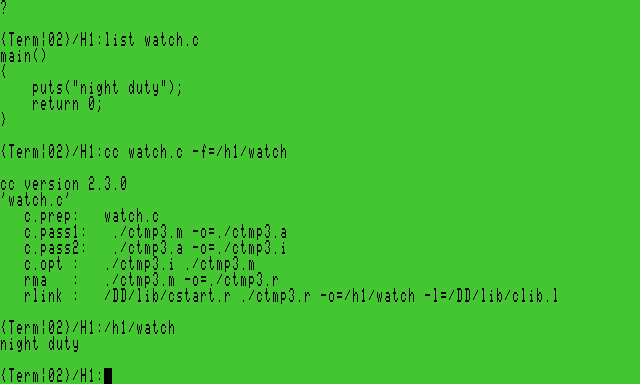
This optional exercise uses the cc version 2.3.0 present on the supplied HD0. Start at Shell+ with the usual /dd/cmds execution directory. Use a personal HD1 with fresh names watch.c and watch. Run:
chd /h1
build watch.c
Type the Watch source, one line per question-mark prompt, and press Return on an empty line to finish. This short program uses the C dialect accepted by the period compiler. Its untyped main() uses the compiler's implicit integer return type. The library routine puts writes a string and ends its line. A return value of zero tells the startup code the program completed successfully.
main()
{
    puts("night duty");
    return 0;
}
Confirm with list watch.c that the opening and closing braces appear on their own lines. In the guest keyboard matrix Control-comma produces the opening brace, and Control-period the closing brace. The Mac's natural keyboard layout also maps brace characters to those combinations.
cc watch.c -f=/h1/watchWait for the shell prompt. The explicit output filename is important. The source lives in the data directory, but the linker treats its final output as an executable. Giving it a full HD1 path keeps that file on your practice disk. The compiler created intermediate files as it worked and printed the stages it invoked.
| Stage shown on screen | Job |
|---|---|
| c.prep | Preprocess the C source, including any requested headers or macro expansions. |
| c.pass1 and c.pass2 | Translate the C program in successive passes. |
| c.opt | Optimize the generated assembly. |
| rma | Assemble a relocatable object whose final addresses can be resolved at link time. |
| rlink | Combine the object with /DD/lib/cstart.r and /DD/lib/clib.l to make the executable. |
/h1/watch
ident /h1/watch
Look for night duty and a return to Shell+. Both guest processors produced a 1,759-byte module with a good CRC of $F01AE3 for this exact source and toolchain. Your seven-instruction Beacon supplied its own entry and exit. This C program also carries the startup and library code needed by what you wrote.
Read further
- Microware Systems Corporation. BASIC09 Programming Language Reference Manual, revision H (1984). See “Introduction to BASIC09 Programming” and “Program Statements and Structure” for procedures, loops and declarations.
- Microware Systems Corporation. C Compiler User’s Guide for OS-9 (1983), chapter 1, “The C Compiler System.” The compiler front end and flags above were checked on the supplied image.
- Tandy Corporation. OS-9 Level Two Development System (1987), “Relocating Macro Assembler,” chapters 1–2, 5 and 9. Use its discussion of sections, external references and the linkage editor when you move beyond a single module.
- The NitrOS-9 Project. NitrOS-9 Technical Reference, revision 0.1 (2004), chapters 3–4 and 8. See the module header layout, standard paths and the system-call interface used in Beacon.